POWERTRAIN
The engine retains the 120° twin-turbo V6 architecture in the ’hot-V’ configuration first introduced on the 296 GTB. On the 296 Challenge Stradale, the concept has been further developed in full line with the racing development philosophy: there is no hybrid component, and the engine, turbocharging system, and transmission have been developed with direct reference to the 296 Challenge. Maximum power is 670 hp at 8,000 rpm. Optimising boost pressure and cam phasers improves low-end response and reduces time to boost. The dedicated driveline features a new flexplate with lightened rotational mass, driveshaft, and casings, designed to transfer torque to the gearbox and ensure reliability in high-performance use.
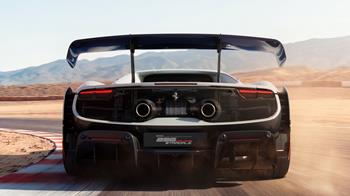
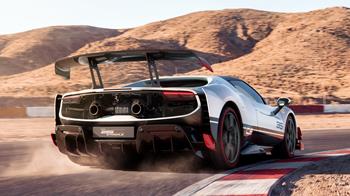
The eight-speed F1 dual-clutch gearbox employs a dual strategy: at high loads and revs, it utilises control logic derived from the 296 Challenge, designed to prioritise speed and continuous torque delivery, whilst at low and medium revs, its dedicated calibration enhances smoothness and driveability. The new exhaust system, featuring twin tailpipes and a larger diameter, reduces back pressure and enhances the V6’s higher-pitched harmonics. The new calibration of the in-cabin sound transmission system alters the balance between the intake and exhaust, complementing the engine’s power delivery right up to its maximum revs of 8,500 rpm.
ENGINE
The calibration of the V6 has been completely overhauled to increase low-end torque, response speed, and performance right up to the rev limiter. The management of boost pressures and variable valve timing during transients increases turbo responsiveness; for the same manoeuvre, dynamic torque is increased by more than 32% compared with the 296 GTB. A statistical knock-control strategy, drawing on experience gained in Formula 1, enables maximum performance to be utilised in every cycle whilst preserving the reliability of the internal components.
The turbochargers and their heat shields are derived from the 296 Challenge. The containment of thermal energy reduces direct heat transfer to the turbines and allows for the removal of protective components that have become superfluous. The new exhaust system features a silencer with twin-tailpipe outlets derived from the 296 Challenge, which have been enlarged to reduce back pressure. The insulated turbines improve energy transfer to the turbocharger assembly, increase responsiveness during transients, and allow for a reduction in thermal shielding within the engine bay.
The timing cover has moved from sand casting to die casting, thereby optimising its wall thicknesses and reducing its weight. The bedplate has moved from a prototype sand-casting solution to shell mould casting, which improves structural performance and fatigue resistance thanks to the different cooling process of the metal.
TRANSMISSION
Upshifts under high load and at high revs employ logic derived from the 296 Challenge, with shift times in the region of 170 ms and maximum priority given to shift speed and torque continuity. At low and medium revs, the new Ferrari sports shift logic – with times in the region of 250 ms, derived from the SF90 XX Stradale – enhances smoothness and driver engagement. When downshifting, faster engine pick-up emphasises the V6’s responsiveness and sound.
SOUND
The 120° configuration and the equal-length exhaust manifolds preserve the engine sound that characterises the 296 GTB and the 296 Speciale, with their pure multiple-of-three engine orders. The ’hot tube’ system picks up the pressure waves before exhaust gas post-treatment and transmits them into the cabin; more permeable materials in the intake plenum connection modify the balance between intake and exhaust, enriching the sound with high-frequency harmonics and raspier notes that build progressively in intensity up to 8,500 rpm.
For the 296 Challenge Stradale, an exhaust system designed exclusively for track use is also available on request; it has been developed to allow the V6 engine to fully express its acoustic potential, free from type-approval constraints. The system, which can be fitted and removed at official Ferrari dealerships, further enhances the engine’s higher-pitched harmonics and the car’s racing character.
AUXILIARY SYSTEMS
The absence of a hybrid system made it necessary to specifically develop certain components, including a mechanical compressor for the air-conditioning system, the Belt Starter Generator (BSG) system with alternator and starter functions – an absolute first for a Ferrari road car – and a new driveline. The new flex plate transmits torque from the flywheel to the gearbox through a single shaft and incorporates the inertia mass required to preserve the correct torsional behaviour of the driveline. The BSG system combines the functions of the starter motor and alternator in a single component, and has been reinforced to increase durability and reliability. The forged flex plate and inertia mass transmit torque and absorb vibrations and oscillations; the driveshaft uses a dedicated alloy, while the casings have been lightened through machining.
VEHICLE DYNAMICS
The entire dynamic development process was based on a methodology similar to that used for race cars. The aim was to enable the driver to harness the car’s potential more naturally, while benefiting from high levels of grip, immediate response to inputs, and consistent behaviour even during long, intensive track sessions.
The 296 Challenge Stradale features a suspension setup with dedicated spring rates and kinematic angles. Reduced weight, increased downforce and a specific setup improve lateral performance and body roll control. The suspension setup also features specific semi-active damper calibrations: the system reduces ride-height variations and balance shifts, optimises the contact patch and limits tyre degradation. Compared with the 296 GTB, maximum lateral performance is increased by 7%, stability is improved by 34%, and the roll gradient is reduced by 68%.
The reduction in weight and the specific calibrations allow the driver to adopt a particularly direct and instinctive driving style. The car enables the driver to brake very close to the limit, maintain high cruising speed, and apply the accelerator early when exiting corners, relying on the high levels of traction available.
The Pirelli P Zero R and P Zero Trofeo RS tyres were developed specifically for the 296 Challenge Stradale. Their casing, tread, and compound are designed to maximise responsiveness, grip, and consistency on the track.
ELECTRONIC CONTROLS AND MANETTINO
The vehicle dynamics controls have been developed to make full use of the car’s hardware and reduce lap times, while maintaining progressive levels of assistance across the various Manettino settings. Predictive slip control and calibration optimised for track use – a first for a Ferrari road car – enable minimal, barely perceptible interventions, while the F80-derived Ferrari Integrated Vehicle Estimator (FIVE) system improves precision in maintaining stability targets on a rear-wheel-drive car.
The ABS Evo, available on the 296 Challenge Stradale in all grip conditions and across all Manettino settings, uses data from the 6D sensor and an advanced speed estimator to maximise braking potential on every surface.
The Manettino offers ‘Wet’, ‘Sport’, ‘Race’, ‘CT-Off’, and ‘ESC Off’ settings. ABS Evo and EBD operate with standard calibration in ‘Wet’ and ‘Sport’ modes, and with high-performance logic from ‘Race’ mode and above. The semi-active suspension adopts a performance-oriented calibration from the ‘Sport’ setting onwards, while the transmission features a sports setup regardless of the Manettino setting selected; the electronic differential and the F1-Trac, ESC, and Ferrari Dynamic Enhancer (FDE) systems progressively modulate their level of intervention through to complete deactivation, which is available only in the most extreme configurations.
BRAKING SYSTEM
At the front, the car features calipers with an Aero design, full-material pads and 398 x 38 mm carbon-ceramic discs, together with higher-flow ventilation ducts required to ensure proper heat dissipation. At the rear, pads with a larger friction surface and 380 x 34 mm discs increase braking torque, cooling, and structural strength. The dedicated cooling system, designed to compensate for the absence of regenerative braking, supports the highest levels of grip and aerodynamic load.
The feel of the brake pedal, developed specifically for this application, differs from the rest of the range in that it is designed to provide the same feel as the brakes on the 296 Challenge Evo while ensuring the traditional advantages in road use that characterise braking systems across the Ferrari range. At high deceleration levels, pedal travel has been reduced, delivering a sportier, more easily modulated feel.
SUSPENSION
The high spring stiffness – approximately double that of previous applications – necessitated the use of a helper spring in series with the main spring, following a racing design directly derived from the 296 Challenge Evo. In addition to holding the main spring in position when the damper is fully extended, it prevents chattering when the main spring becomes unloaded during the rebound phase.
CHASSIS AND BODY
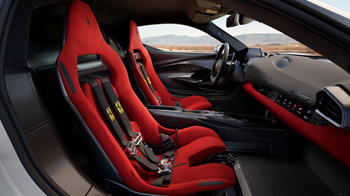
The 296 Challenge Stradale’s chassis has been developed to reduce weight and support higher levels of aerodynamic downforce and grip. Its dry weight of just 1,330 kg is also attributable to the absence of hybrid systems, the dedicated driveline, lightweight components, and the racing-style cockpit configuration. Weight-saving features include the carbon-fibre rear wing and bonnet trim, forged wheels, and tubular seats. An even sportier cockpit specification is available on request, which leaves the chassis and structural surfaces partially exposed.
TYRES
The Pirelli P Zero R and P Zero Trofeo RS semi-slick tyres use a casing, tread, and compound specifically developed for the 296 Challenge Stradale. Their construction increases cornering precision by controlling yaw and response speed, while maintaining consistent performance and balance during high-performance track use. Pirelli Color Edition technology enables tyre colour customisation through co-vulcanised inserts. In addition to absolute grip levels, development was focused on ensuring repeatable performance and consistent behaviour even during prolonged track use.
DRIVING ASSISTANCE SYSTEMS
The equipment package includes Adaptive Cruise Control, Automatic Emergency Brake with vehicle, pedestrian, and cyclist detection, Automatic High Beam Matrix, Lane Departure Warning and Lane Keeping Assist, Traffic Sign Assistance, Driver Drowsiness and Attention, Advanced Driver Distraction, Blind Spot Detection, Rear Cross Traffic Alert and Dual Camera. Front and rear radars, a windscreen-mounted camera, a steering column-mounted camera, and dedicated control units are integrated into the vehicle architecture; the functions can be configured via the instrument cluster menus.
The Matrix LED system selectively modulates the high beam and adapts the low beam to urban, motorway, and wet-weather conditions. The Dual Camera uses a front and rear camera to assist with manoeuvring. The monitoring systems assess fatigue and distraction by analysing driving behaviour, lane position, and gaze direction.
THERMOFLUID DYNAMICS
The 296 Challenge Stradale generates 617 kg of downforce at 250 km/h. The aerodynamic system draws on the 296 Challenge Evo not only in terms of certain components, but also in terms of an overall philosophy focused on stability, efficiency, and fully harnessing performance.
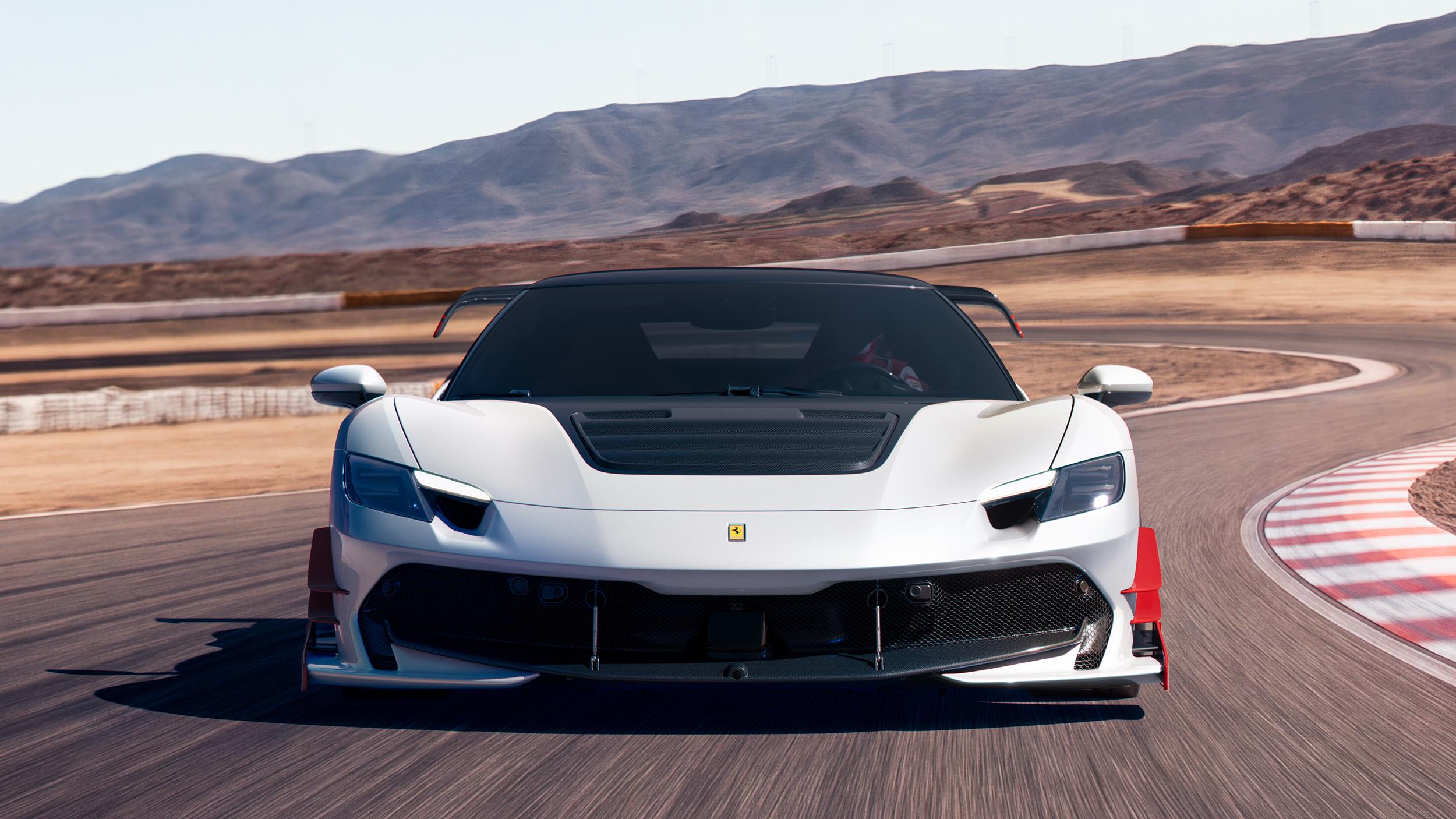
At the front, the splitter, flick, side wings, and endplate manage the airflow around the bumper and wheels, supporting the underbody’s aerodynamic performance. The closed underbody maintains airflow quality beneath the chassis and feeds the front diffuser, vortex generators, and rear diffuser. The aero damper reduces downforce sensitivity to pitch variations, delivering a more linear response.
Thermal management is integrated into the aerodynamic system. Two water radiators and two condensers are positioned ahead of the front wheels; hot air is routed towards the bonnet through dedicated ducts and subsequently directed towards the windscreen and roof, avoiding interference with the main aerodynamic surfaces.
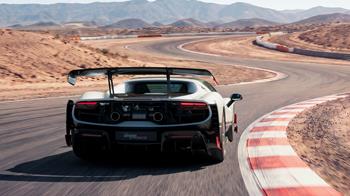
At the rear, the fixed wing – derived directly from the 296 Challenge Evo – generates 270 kg of downforce at 250 km/h and works in synergy with the diffuser and vortex generators. The diffuser strakes control the distribution of airflow and wheel wake, maintaining the effectiveness of the central channels.
Development involved thousands of hours of CFD simulations, hundreds of hours in the wind tunnel, and collaborative work with the Ferrari Design Studio. Each solution was validated across various setup conditions, with the aim of achieving a smooth and progressive aerodynamic load response. The joint work on aerodynamics, tyres, and vehicle setup made it possible to maintain an extremely stable vehicle balance through the various phases of a corner, even during high-speed direction changes and under intensive track use.
AERODYNAMICS
The splitter, which extends both transversely and longitudinally, maximises the effective surface area. The front underbody is designed at a height compatible with everyday driving, and with a ramp angle appropriate for speed bumps and variations in the road surface. The extensive redesign of the underbody and the splitter-to-floor transition increase suction; three pairs of vortex generators at the front and two at the rear generate vortex patterns that enhance downforce generation.
The curved flick elements on the bumper cheek work together with the side wings and endplate to create outwash and direct airflow around the outside of the wheel arch. The terminal nolder intensifies vortical flow. The system improves the operating conditions of the front diffusers and vortex generators, while promoting the extraction of hot air from the brake area.
Two lateral ducts, also featured on the 296 Challenge Evo and known as aerodampers, positioned on the outside of the front luggage compartment, connect the floor and the upper section of the car. The system reduces downforce sensitivity to pitch variations and helps confine the hot air expelled from the bonnet along the centreline, preventing interference with the climate control intakes.
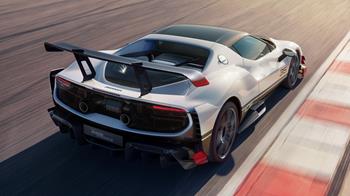
The fixed wing features a broad transverse span and an elevated position to maximise downforce and limit interference with the bodywork, while preserving rear visibility. The aeronautically inspired endplate elements increase rear-wing efficiency by optimally managing wingtip vortices. The same concept is also found on the 296 Challenge Evo.
THERMAL MANAGEMENT
Two water radiators and two condensers are positioned ahead of the front wheels, outside the front luggage compartment, and fed by the side intakes in the bumper. After passing through the heat exchangers, the air is collected by ducts between the radiators and the front luggage compartment and discharged upwards through the bonnet louver. Fins and deflectors organise the flow towards the windscreen and roof, keeping it away from the climate control intakes. A further opening on the bumper cheek exploits the low-pressure area generated by the lower flick to extract hot air.
DESIGN EXTERIOR
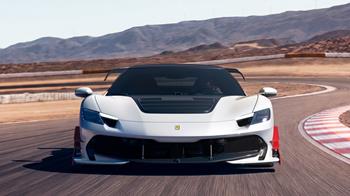
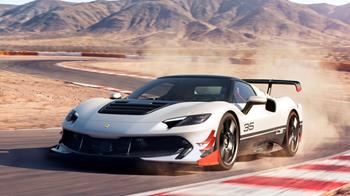
The 296 Challenge Stradale was developed in close continuity with the 296 Challenge Evo, with the aim of preserving its identity as far as possible. The result is a distinctly racing-inspired design, in which the front and rear surfaces are visually streamlined to make the technical functions more clearly discernible. Its distinctive elements arise from the interplay between this approach and the aerodynamic requirements, stylistic considerations, and the type-approval constraints inherent to a road car. The Ferrari Design Studio, led by Flavio Manzoni, sought to make the car's performance and purpose immediately apparent through every design detail.
The front end is dominated by the large technical insert on the bonnet – which incorporates the air outlet from the radiators – and by the two openings near the windscreen that draw air directly from the underbody, thereby helping to generate downforce. The front bumper features a wing suspended between two body-coloured ‘claws’, echoing the front-end layout of the 296 Challenge Evo. At the ends of the bumper are two distinctive air intakes that visually widen the front end. Two flick elements have also been fitted at the sides to increase aerodynamic load.
The layout of the front luggage compartment has been designed with the car’s racing heritage in mind: when the bonnet is opened, the space is deliberately minimalist and free of any unnecessary elements.
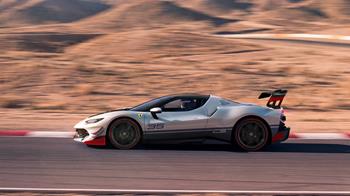
The side view retains the compact character of the 296 GTB, reinterpreted through functional appendages and details. The rear is dominated by the fixed wing, supported by hollow struts, and by a black metal mesh that leaves the technical components and exhaust tailpipes visible. The silhouette is completed by the two side wings that frame the design of the rear bumper. The diffuser features two protruding keels, a clear nod to the technical design of the 296 Challenge Evo’s diffuser. The wheels feature a technical architecture with seven twin-spokes, developed with clear racing inspiration.
INTERIOR
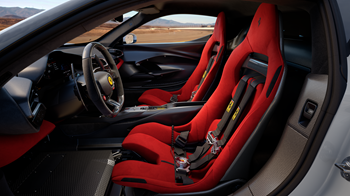
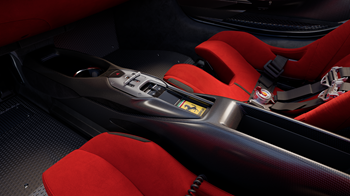
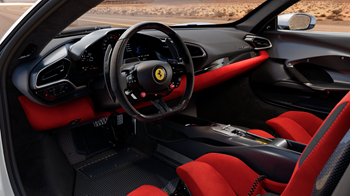
The cockpit follows the layout of the 296 GTB but can be configured in a more extreme specification, stripping away non-essential elements to evoke the feel of a race car. The door panel is made from a single carbon-fibre component, with no armrest or storage pocket. For the first time on a production car, inspired by the 296 Challenge, an optional specification is available that removes all superfluous trim from the area beneath the seats, the lower section of the carpets, and beneath the centre console, leaving part of the chassis exposed. The central tunnel adopts a deliberately minimalist design: the front fork-shaped element is made of carbon fibre and incorporates the gear selector gate, cupholder, and wireless charging station, while the rear section is entirely made of carbon fibre.
CUSTOMISATION COLOURS AND MATERIALS
The livery, available on request, features a bonnet badge, roof graphics, and a strip running along the lower part of the side panels, the bumpers, and the rear wing. Customisable accents highlight the front spoilers and diffuser. The wheels can be ordered in Matte Grigio Corsa, Matte Nero with a diamond-cut finish, or Matte Bianco Fuji; the latter, with its subtle metallic effect, particularly emphasises the wheel’s sculptural form. In the interior, a specific combination of materials – technical fabric and Alcantara® – reinforces the car’s sporty character.
OPTIONAL EQUIPMENT
Available equipment includes the carbon-fibre bonnet trim (-0.7 kg) and forged wheels in various seven twin-spoke finishes, which reduce unsprung mass by approximately
11.9 kg (while the carbon-fibre wheels introduced on the 296 GTB naturally remain available). The monolithic aluminium rear tunnel is integrated with black trilobate footrests for the driver and passenger. The carbon-fibre tubular seats, introduced on the SF90 XX Stradale, offer support comparable to that of a race-car seat and reduce weight by 25% compared with standard racing seats. Alcantara® upholstery is available in Nero, Charcoal, Rosso, Azzurro Dino, Giallo Modena, Blu Elettrico, and Rosso Dino, also with contrasting piping and accents.
GENUINE MAINTENANCE
Ferrari’s unparalleled quality standards and exceptional customer care form the basis of its seven-year extended maintenance programme, which is also available on the 296 Challenge Stradale. This programme, which applies across the entire range, covers scheduled maintenance for the first seven years of the car’s life.
The main benefits of the Genuine Maintenance programme include scheduled servicing at intervals of 20,000 km or once a year, with no mileage limit, genuine spare parts, and inspections carried out using state-of-the-art diagnostic equipment by personnel trained at the Ferrari Training Centre in Maranello.
TECHNICAL SPECIFICATIONS
INTERNAL COMBUSTION ENGINE
Type V6 – 120° – Turbo – dry sump
Total displacement 2,992 cm³
Bore and stroke 88 x 82 mm
Maximum power 670 cv at 8,000 rpm
Specific power output 224 cv/l
Maximum torque 740 Nm at 6,250 rpm
Maximum engine speed 8,500 rpm
Compression ratio 9.4:1
DIMENSIONS AND WEIGHT
Length 4,678 mm
Width 2,039 mm
Height 1,301 mm
Wheelbase 2,600 mm
Front track 1,678 mm
Rear track 1,654 mm
Dry weight* 1,330 kg
Dry weight-to-power ratio 1.98 kg/cv
Weight distribution 41.5% front / 58.5% rear
Front luggage compartment capacity 67 l
Rear bench capacity 88 l
Fuel tank capacity 64.5 l TYRES
Front 245/35 R20 Rear 305/35 R20
BRAKES
Front CCM disc 398 x 38 mm
Rear CCM disc 380 x 34 mm
TRANSMISSION AND GEARBOX
F1 dual-clutch transmission, 8 gears
ELECTRONIC CONTROLS
SSC 9.0: TC, eDiff, SCM, FDE 2.0, EPS
High-performance ABS Evo/EBD: All Range, All Grip
PERFORMANCE
Top speed >300 km/h
0–100 km/h 2.8 s
0–200 km/h 7.9 s
200–0 km/h 101 m
Dry weight-to-power ratio* 1.98 kg/cv Fiorano lap time 1’ 18” 500
FUEL CONSUMPTION AND EMISSIONS
WLTP fuel consumption Pending homologation