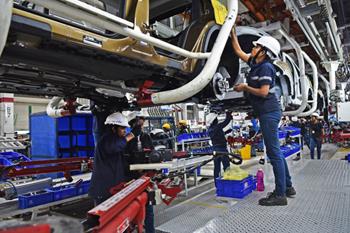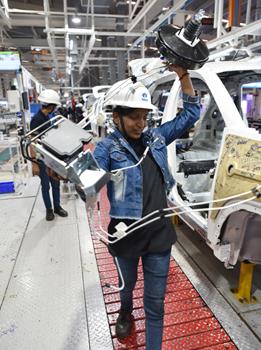
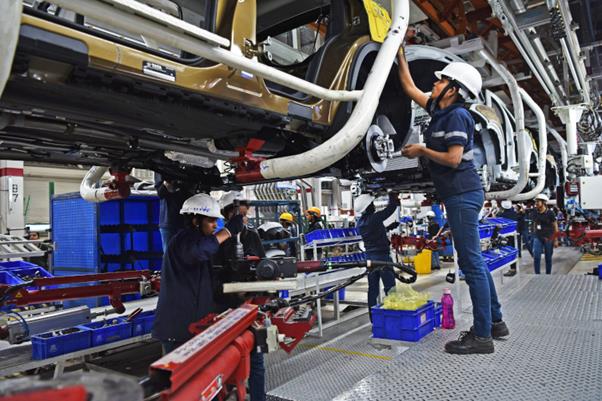
- Tata Motors operate the world’s few women-led and run vehicle production facility.
- The highly capable TATA Harrier is built entirely by women.
- Tata Motors South Africa employ women across all areas of their business.
Johannesburg, South Africa — As the world celebrates International Women’s Day, Tata Motors are proud that their organisation is both diverse and empowering to women, across all facets of their business.
This approach begins at the inception of the brand’s incredible products in India and continues onto local sales floors.
Tata Motors have put women in the frontline of Indian vehicle manufacturing with an all-women vehicle assembly line.
Since 2020, more than 1 700 women from some of the most remote corners of Maharashtra have been employed at the Tata Motors Passenger Vehicle plant in Pimpri-Chinchwad, Pune. This plant is responsible for models such as the Tata Safari and Harrier,
Women enter the plant as trainees and receive both on-ground and technical training on the job, allowing them to graduate into a variety of positions within the wider automotive market. Tata Motors also offers support and guidance to employees who wish to further their studies with engineering master’s courses. This initiative ensures continuous personal development and self-growth.
The idea behind an all-women production line was driven by a desire to transform the traditionally male-dominated industry by placing women at the heart of Tata’s operations.
Tata Motors engineers designed this plant in such a way that women are able to do all the jobs that were traditionally reserved for their male counterparts. This included ergonomic enhancements such as the use of manipulators and robotics, raised workstations and redesigned lifts, hoists and torquing tools. The result is a workplace that is more accessible to women, while many of these learnings were also subsequently incorporated into other plants, easing the physical workload of employees, no matter their gender.
Many companies have attempted all-women’s manufacturing facilities in the past and haven’t experienced the same level of success. By looking at the basics, Tata Motors has been able to lead the way. This includes hygiene, safety and a good work culture where women can feel inspired and Tata Motors provides this.
Locally Tata Motors South Africa has adopted a similar approach. “Inspired by the women from the Pimpri-Chinchwad plant, Tata Motors South Africa has been intentional in employing women across our organisation, from leadership roles to marketing and aftersales,” says Daphne Greyling, General Manager: Dealer Sales, Tata Motors Passenger Vehicles South Africa.
Tata Motors South Africa now boast an extensive dealer network of more than 40 dealers across South Africa and a large percentage of the employees in these facilities are also women.
“Buying a car might be a substantial financial undertaking but it is also an emotional decision. We still believe that people do business with people, but the automotive industry can be daunting for women. We have seen first-hand how our female customers are considerably more comfortable dealing with a women when they are shopping for a new car, doing a finance application or booking their Tata in for a service,” says Greyling.
In celebration of International Women’s Day, Tata Motors South Africa are excited that they can close the loop and allow women to empower other women.
“There is no greater celebration of women empowerment than female motorists being able to buy a car that was built by a woman from another woman,” concludes Greyling.
Follow Tata Motors South Africa: @TataCarsPV_SA
Visit: www.tatacars.co.za
–Ends–